The space economy is finally becoming a real business. Not a science project. Not a moonshot fantasy. A real commercial market with government customers, private companies, satellites, data, telecom demand, and defense applications all pulling in the same direction.
That is why investors are suddenly paying attention.
SpaceX going public would be enough to light a fire under the sector on its own. It is one of the most recognizable companies in the world, and its IPO brought even more attention to space stocks. But the bigger story is not just SpaceX. The bigger story is that the space market is becoming commercially viable.
The global space economy is expected to reach about $1.01 trillion by 2034. That kind of number gets investors excited.
But here is where I think many people get it wrong.
Not every space stock is playing the same game.
Some companies are focused on launch. Others are focused on infrastructure. And if I had to pick the side with the better long-term opportunity, I would pay close attention to infrastructure.
The Space Market Has Two Very Different Sides
When investors talk about “space stocks,” they often lump everything together.
That is a mistake.
The space economy has two major categories:
- Launch
- Infrastructure
Launch companies build and operate rockets. They get satellites, defense systems, lunar payloads, and commercial assets into space.
Infrastructure companies focus on what happens after those assets are in orbit. That can include satellites, communications networks, Earth-observation data, spacecraft components, solar systems, sensors, software, and recurring services.
Both matter.
But they do not have the same economics.
Launch Is Essential, But It Is Brutal
Launch is the foundation of the space economy.
Before a satellite can collect data, before a telecom network can connect phones from orbit, before a defense system can track threats, and before a lunar mission can begin, something has to get the payload into space.
So yes, launch companies are important.
The best launch businesses can carry heavier payloads, launch more often, and do it reliably. That gives them a strong position in the market.
But there is a major problem.
Rockets are expensive.
Launch costs have declined over the last 20 years, but this remains a capital-intensive business. A failed launch can be costly. Multiple failed launches can put serious pressure on a company’s future.
That is what makes launch exciting and dangerous at the same time.
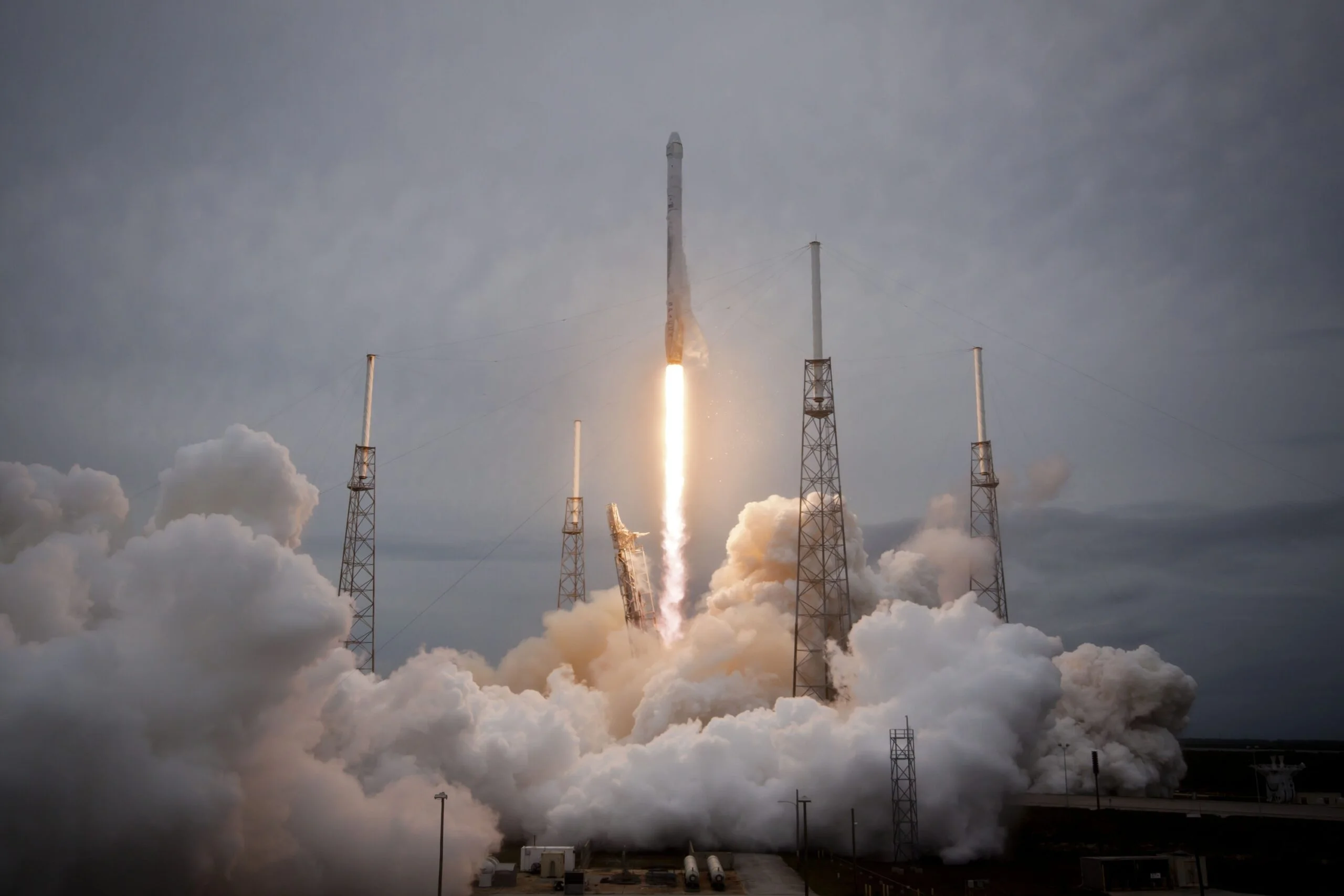
SpaceX Shows the Risk Inside the Rocket Business
SpaceX is the obvious example.
The company was founded in 2002 to reduce spaceflight costs. Over the years, it built major launch systems, including Falcon 1, Dragon 1, Falcon 9, and other rocket classes.
It is one of the most exciting companies in the space market.
But even SpaceX shows how tough the launch business can be.
In the first quarter of 2026, SpaceX’s Space segment lost $662 million from operations.
That is after more than two decades of progress.
And this is not just a theoretical risk. Back in 2008, SpaceX nearly went bankrupt after three failed Falcon 1 launches.
That is the cold reality of the launch business. Even when the company is brilliant and the technology is improving, rockets still cost a fortune.
So how does a space company survive?
It monetizes more than launch.
The Real SpaceX Story May Be Starlink
SpaceX does not just launch rockets. It uses its launch capacity to build Starlink.
That matters.
In the first quarter of 2026, SpaceX’s Connectivity segment, which is mostly Starlink, generated about $3.26 billion in revenue. That represented roughly 69% of SpaceX’s total quarterly revenue.
That is the lesson investors should not ignore.
The rocket gets the payload into orbit. But the network creates a bigger recurring revenue opportunity.
This is why infrastructure may be the more interesting side of the space market.
A rocket launch is a mission. Infrastructure can become a platform.
Why Infrastructure Could Be the Better Space Investment
Once satellites are in orbit, the business does not stop.
Those satellites need systems, power, software, communications, data platforms, ground networks, and customers. They can support telecom services, imaging, defense, analytics, bandwidth, navigation, and recurring commercial contracts.
That is where space starts to look less like a risky launch business and more like a recurring industrial market.
A launch company may need to keep winning the next mission.
A satellite infrastructure company may be able to sell its services repeatedly.
That is a very different business model.
And we are already seeing this shift in some of the most interesting space companies in the market.
Rocket Lab Is No Longer Just a Launch Story
Rocket Lab is a good example.
At first, investors focused on its rockets. The company’s Electron rocket was designed for small payloads and included reusable parts. Then Rocket Lab expanded its launch story with HASTE, the Hypersonic Accelerator Suborbital Test Electron.
HASTE gave the company a stronger defense angle because it can be used for hypersonic and suborbital testing. That includes testing vehicles, sensors, guidance systems, communications equipment, and missile-defense technologies.
The original thesis was simple: more rockets should mean more money.
But rocket development is expensive. In 2023, Rocket Lab’s operating margins were negative 73%.
That is why the company’s shift toward infrastructure matters so much.
Rocket Lab’s Space Systems segment now builds hardware and software for satellites and spacecraft. That includes solar power systems, reaction wheels, star trackers, radios, separation systems, software, and full spacecraft platforms.
In the first quarter of 2026, Space Systems grew 57% year over year and accounted for around 68% of Rocket Lab’s total revenue.
Back in the fourth quarter of 2025, Space Systems accounted for 74% of its backlog, with most of that from government clients.
That is the part investors should watch.
Rocket Lab still benefits from launch demand, but its biggest growth driver is now infrastructure.
AST SpaceMobile Is Betting on Phones From Space
AST SpaceMobile is another kind of infrastructure play.
It is not building rockets. It is not trying to become the next SpaceX. It is not selling spacecraft parts.
Its product is a satellite network designed to connect directly to ordinary smartphones.
That means no special satellite phone. No extra equipment. Just regular smartphones connecting through space-based coverage.
The potential use cases are easy to understand.
Rural areas. Remote highways. Mountains. Oceans. Disaster zones. Energy sites. Mining operations. Agricultural regions.
Anywhere traditional cell towers are weak, expensive, or unavailable could present an opportunity for AST.
The company is also working with mobile network operators instead of trying to replace them. Partners include names like Verizon, AT&T, Vodafone, Rakuten, and Bell Canada.
That strategy makes sense because these carriers already have customers, billing systems, distribution, and brand trust. AST can serve as an additional infrastructure layer that fills gaps in existing coverage.
But this is still early.
In its first-quarter financials, AST generated $14.7 million in revenue while its direct-to-device network was still being deployed and scaled.
The company has demonstrated voice, video, and 5G calls from space to unmodified smartphones. But the real question is whether it can launch enough satellites, enter commercial service, and generate recurring revenue from the network.
That is what investors need to watch.
Planet Labs Is Turning Earth Data Into a Business
Planet Labs shows another side of the space infrastructure opportunity.
The company builds and operates Earth-observation satellites. Then it sells imagery, data, and analytics.
This can be useful across agriculture, forestry, mapping, energy infrastructure, defense, disaster response, climate, supply chains, and government intelligence.
The idea is simple.
If you can monitor changes on Earth every day, that information can become valuable.
Farmers can monitor crop health. Governments can track border activity or disaster damage. Energy companies can watch pipelines and remote assets. Supply chain operators can monitor ports, shipping routes, construction sites, and industrial activity.
Planet does not need to launch a new satellite every time a customer wants data. Once its satellites are in orbit, it can sell access to imagery, monitoring tools, analytics products, and historical datasets to many customers across multiple industries.
That is the infrastructure model.
However, Planet still has work to do.
According to its fiscal 2027 first-quarter financials, revenue grew 42% year over year to a record $94 million. But the company is still operating at a loss.
That is a familiar issue in the space sector.
The growth stories are exciting, but many of these companies are still trying to prove they can become profitable.
The Bottom Line
The space economy is exciting, but investors need to be selective.
Launch companies matter because nothing gets to orbit without them. But launch is expensive, risky, and often dependent on the next contract.
Infrastructure may offer a better long-term setup.
That is where satellites, data, connectivity, government demand, and recurring customer relationships can become real revenue over time.
SpaceX shows it with Starlink. Rocket Lab shows it with Space Systems. AST SpaceMobile is trying to prove it through direct-to-device connectivity. Planet Labs is trying to prove it using Earth observation data.
Not every company will win. Some may struggle. Some may keep losing money. Some may fail to scale.
But the framework is what matters.
When looking at space stocks, do not stop at the rocket. Ask what the company can sell after launch. Ask whether the revenue can be repeated. Ask whether the business is built around one mission at a time, or around a platform that can keep generating value once it is in orbit.
That may be where the real opportunity in space stocks begins.