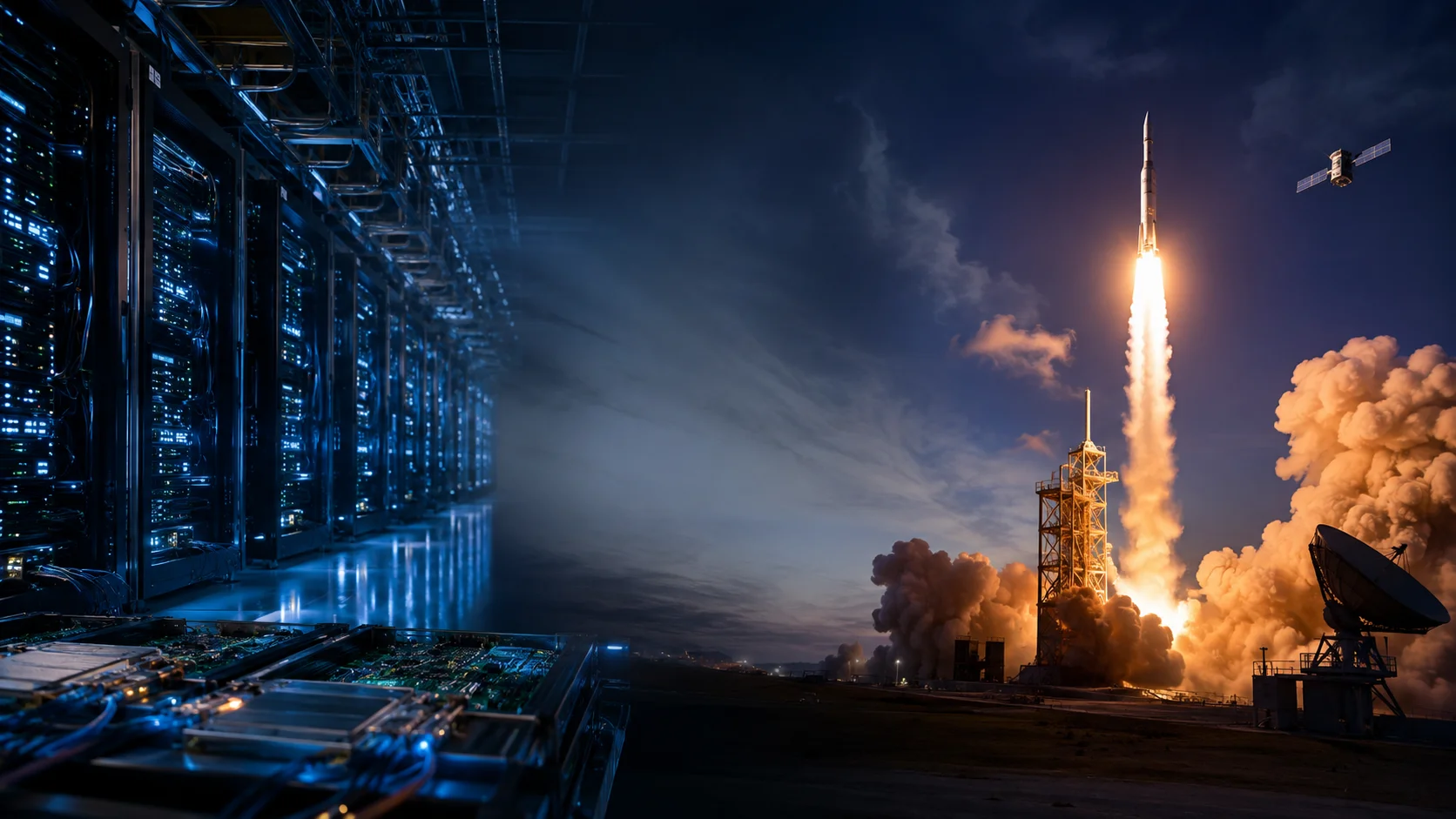
Artificial intelligence is already producing billions in revenue. Space could offer even greater upside, but investors may have to wait much longer for the economics to catch up.
That leaves investors facing one of the most important sector debates in the market today: AI vs. space stocks.
Palantir, Micron, and Nebius are already turning the AI boom into contracts, infrastructure spending, and measurable revenue. SpaceX, Rocket Lab, and Redwire are building toward markets that could become just as important, but much of their potential still depends on future execution.
The choice comes down to safety versus upside.
AI offers proven demand and clearer cash-flow potential. Space offers moonshot growth, but with longer timelines, higher volatility, and far less certainty.
The strongest investments in either sector may not be the companies generating the most excitement. They may be the businesses supplying the picks and shovels that every competitor needs.
A Growing Market Does Not Guarantee Growing Stocks
Investors often assume that identifying the right industry is enough.
It is not.
A sector can grow rapidly while most of the companies inside it struggle. In winner-takes-all markets, a small group of businesses can capture most of the value while weaker competitors burn cash, issue more shares, or disappear.
AI and space are both capital-intensive sectors. Companies need technical expertise, expensive infrastructure, large customer bases, and sufficient financing to survive long development cycles.
That makes competitive position more important than the size of the market alone.
The companies most likely to succeed usually control something difficult to replace, such as:
- Critical software
- Advanced memory and chips
- Scarce computing capacity
- Launch infrastructure
- Satellite components
- Government relationships
- Long-term customer contracts
This is why picks-and-shovels investing can be so powerful.
Instead of trying to predict which final product will dominate, investors can focus on the infrastructure that successful products cannot operate without.
AI Already Has What Space Is Still Trying to Build
The strongest argument for AI is not that it could transform the economy.
It is that AI is already generating real revenue.
Palantir is signing contracts. Micron is supplying memory. Nebius is building data centers and securing power capacity.
These companies are not waiting for a future market to arrive. They are serving customers today.
That gives AI a level of commercial visibility that most space investments still cannot match.
Palantir Is Turning AI Into Business Decisions
Palantir Technologies captures one of the strongest parts of the AI investment case.
Many companies are focused on building large language models. Palantir is focused on helping organizations use those models inside real operations.
Its Foundry platform helps companies combine fragmented data, manage supply chains, and improve decision-making. Gotham serves government, defense, and intelligence customers. Its Artificial Intelligence Platform, known as AIP, allows organizations to deploy AI agents inside workflows while maintaining security, governance, and human oversight.
This distinction matters.
As AI models become more widely available, they may become less differentiated. The harder problem will be connecting them to sensitive data, internal systems, and real-world decisions.
Palantir is trying to own that layer.
First-quarter revenue reached $1.63 billion, up 85% year over year. Total contract value increased 61% to $2.41 billion, while U.S. commercial revenue climbed 133% to $595 million.
Management also raised its full-year 2026 revenue guidance to between $7.65 billion and $7.66 billion.
Palantir is not selling a distant vision of AI adoption. It shows adoption through signed contracts and reported revenue.
Micron Supplies the Memory AI Cannot Run Without
Software may get most of the attention, but AI requires an enormous amount of physical infrastructure.
It needs processors, networking equipment, data centers, power, cooling, and advanced memory.
That brings Micron into the discussion.
High-bandwidth memory, or HBM, is designed to move huge amounts of data quickly between processors. NVIDIA GPUs, AMD accelerators, and custom AI chips all require substantial memory capacity.
Micron is one of the world’s three major DRAM manufacturers, placing it in a strong position as AI infrastructure spending expands.
For decades, investors treated memory manufacturers as cyclical commodity businesses. AI could change that dynamic by creating sustained demand for increasingly advanced products.
Micron also secured 16 Strategic Customer Agreements across data centers, consumer devices, and automotive customers. Many of those agreements run from 2026 through 2030.
Those contracts could improve revenue visibility and reduce some of the uncertainty associated with traditional memory cycles.
Palantir provides the software layer. Micron supplies a physical component that AI systems cannot function without.
Nebius Is Building AI Factories
Nebius represents another critical part of the AI infrastructure stack.
Instead of developing a flagship AI model, the company is building the computing capacity those models require.
Major AI labs and hyperscalers need access to GPUs, power, networking systems, and data-center space. Demand for that infrastructure continues to exceed supply.
Nebius has secured 3.5 gigawatts of contracted power capacity and is targeting more than four gigawatts by year-end. It has also expanded through large sites in Pennsylvania and Finland.
The company expects to generate approximately $3 billion to $3.4 billion in 2026 revenue and reach an annualized run-rate revenue of $7 billion to $9 billion.
Its customer pipeline expanded 3.5-fold in the first quarter compared with the previous quarter.
Most notably, Nebius secured a five-year Meta contract worth up to $27 billion. It also received a $2 billion investment from NVIDIA and expanded its partnership with the company.
Nebius does not need to predict which AI model will win.
It can benefit as long as the industry continues demanding more computing capacity.
The Biggest Risk for AI Stocks Is Valuation
AI has clearer demand, stronger revenue visibility, and more established commercial use cases.
That does not mean every AI stock is attractive.
A great company can still be a poor investment when its valuation assumes years of nearly flawless growth.
Investors have already priced enormous expectations into many AI businesses. Some companies may grow fast enough to justify those expectations. Others may be trading more on excitement than fundamentals.
This is where the AI bull case becomes more complicated.
A company can have an excellent product, a large addressable market, strong revenue growth, and an overpriced stock at the same time.
AI may be the safer sector operationally, but it is not automatically the safer sector from a valuation perspective.
Space Stocks Offer a Bigger Dream and a Longer Wait
Space investing presents almost the opposite proposition.
The potential markets include:
- Satellite broadband
- National security
- Earth observation
- Launch services
- Deep-space missions
- Missile testing
- In-orbit manufacturing
- Autonomous defense systems
The opportunity is easy to understand.
The economics are harder to predict.
Many space companies still need to prove that contracts and backlogs can produce sustainable profits. Investors must accept delays, technical failures, cost overruns, financing risk, and long development timelines.
That uncertainty creates the potential for extraordinary returns, but it also creates more ways to lose.
SpaceX Combines Proven Businesses With Speculative Bets
SpaceX is no longer just a rocket company.
Its business includes Falcon launches, Starlink satellite broadband, government contracts, national-security services, and artificial intelligence following its acquisition of xAI.
Its Starshield operation provides secure communications, Earth observation, and hosted payload capabilities for government customers.
Through xAI, the company also operates Colossus, an AI training supercomputer containing more than 200,000 NVIDIA GPUs.
This diversification gives SpaceX several potential growth engines.
However, not all of them are equally proven.
Launch services and Starlink are established businesses. The economics of its newer AI operations remain less predictable.
SpaceX may eventually become a dominant platform across launch, broadband, defense, and AI. Investors still need to separate the businesses generating value today from the projects that may generate value years from now.
Rocket Lab Is Becoming a Space Infrastructure Company
Rocket Lab may offer one of the most interesting public-market opportunities in the space sector.
The company began as a small-launch provider, but it has expanded into satellite manufacturing, defense, hypersonic testing, and broader space systems.
Electron remains its best-known rocket. HASTE supports hypersonic flight testing for the U.S. government. Neutron, its planned reusable medium-lift rocket, could allow the company to compete for larger missions and satellite constellations.
Rocket Lab signed 36 new launch contracts in the first quarter of 2026, lifting its contracted manifest above 70 missions. Its backlog reached a record $2.2 billion.
The company also booked 20 HASTE launches under a $190 million Defense Department contract.
More importantly, Rocket Lab’s space systems division already generates most of its revenue.
That reduces its dependence on Neutron and gives the company a stronger infrastructure case than a business that relies entirely on a single future rocket.
Rocket Lab is not dependent on a single product, but much of its largest upside still requires successful execution.
Redwire May Be the Quiet Space Picks-and-Shovels Play
Redwire receives less attention than launch companies, but its business may fit the infrastructure thesis more directly.
The company supplies components and systems used across satellites, spacecraft, and defense platforms.
Its products include satellite components, solar arrays, in-space manufacturing systems, tactical drones, and autonomous defense technology.
This diversified model reduces its dependence on one launch vehicle or mission.
First-quarter revenue reached $97 million, up 57.9% year over year. Gross margin improved to 26.6% from 14.7%, while backlog reached a record $498 million.
Redwire also expanded into defense technology through its acquisition of Edge Autonomy.
The company secured a $21.5 million follow-on U.S. Navy order for Stalker Block 30 unmanned aircraft systems for the Marine Corps. It also won a contract to supply Penguin Mk2.5 vertical-takeoff drones to Taiwan’s Coast Guard.
Redwire is not selling the glamour of space travel.
It is supplying tools that space and defense customers need to operate.
AI vs. Space Stocks Comes Down to Safety vs. Upside
The difference between AI and space comes down to what an investor is willing to pay for certainty.
AI offers:
- Revenue at scale
- Established customers
- Immediate commercial demand
- Clearer operating leverage
- Lower execution risk
Space offers:
- Earlier exposure to emerging markets
- Greater potential upside
- Expanding defense applications
- Falling launch costs
- The possibility of entirely new industries
The price of that upside is uncertainty.
AI leaders are scaling businesses that already work. Space companies are trying to prove that current contracts, launch systems, and infrastructure can support much larger businesses in the future.
AI could disappoint because valuations have become disconnected from fundamentals.
Space could disappoint because the fundamentals never develop as quickly as investors expect.
Which Sector Has the Stronger Investment Case?
AI currently has the stronger near-term investment case.
Palantir, Micron, and Nebius are supporting existing demand. They have customers, contracts, and measurable revenue opportunities.
SpaceX, Rocket Lab, and Redwire are building infrastructure for markets that could become much larger, but investors must accept longer timelines and less predictable earnings.
That does not mean AI will produce the highest returns.
If launch costs continue falling, satellite demand expands, defense spending rises, and space companies successfully scale their platforms, the upside could be far greater.
But in a winner-takes-all market, choosing the right sector is not enough.
Investors still need to choose companies with durable infrastructure, real customers, sufficient capital, and enough time to survive until the opportunity matures.
AI offers proof. Space offers possibility.
The better investment depends on whether you value visible cash flow today or asymmetric upside tomorrow.
Which side are you taking?
Is AI’s immediate cash flow worth today’s valuations, or has Wall Street already priced in too much success?
And does space infrastructure offer the stronger long-term opportunity, or is the sector still driven more by promise than proven economics?
Share your view in the comments below.